
Mesa County Court Records After Arrest
In Mesa County, a jail booking and a court case are related but not identical. The Mesa County Detention Facility records the custody event, booking number, bond clues, and recent booking data. The formal court record is maintained by Colorado Judicial for the 21st Judicial District after a complaint, information, indictment, ticket, or other filing opens or updates a case. The 21st Judicial District Attorney's Office, led by District Attorney Daniel P. Rubinstein, decides what criminal charges to file after an arrest.
Booking charges can differ from filed charges. A jail profile may show an arrest charge or a bond-related charge row, but the court record may later show amended, reduced, dismissed, or additional charges. For the custody side, use Mesa County jail inmate records. For booking photos, use the separate Mesa County jail mugshots page. The court route is for hearings, charging documents, dispositions, protection orders, and sentence records.
How Arrest Becomes Court Records
The arrest-to-court pathway starts at MCDF. The Detentions Division accepts arrestees from law-enforcement agencies across Mesa County. First advisements can occur from inside the jail through video, and later proceedings can use the secure tunnel connection to the Mesa County Justice Center. That local setup explains why court records after a jail arrest may begin before a person physically leaves the jail building.
A practical flow is: Arrest - Booking - First advisement or bond hearing - Prosecutor filing - Court docket - Disposition or sentence. Bond may appear on the jail profile after a judge addresses release conditions. The court docket then becomes the better source for hearing dates, case numbers, filed documents, and the final case outcome.
Search Mesa County Court Records After Arrest
The main official search route is the Colorado Judicial docket system, narrowed to Mesa County or the 21st Judicial District when possible. The docket search is not a complete online file cabinet. It returns hearing and docket result fields, while copies of complaints, disposition orders, protection orders, tickets, or the Register of Action must be requested through the clerk or the statewide record/document request form.
- Use the Mesa County Inmate Locator or Booking Summary Report to confirm custody, name, and booking context.
- Search the Colorado Judicial docket page by Mesa County, defendant name, case number if known, and a date range.
- Review result fields such as date, time, name, case number, hearing type, location, appearance type, and courtroom.
- Use the case number, party name, and date of birth when requesting court documents.
- Submit a Colorado Judicial record/document request when the docket does not supply the document itself.
The Mesa County court page lists the local court at 125 N. Spruce St. in Grand Junction. Building hours are Monday-Friday, 7:30 a.m.-5:00 p.m.; the Clerk's Office is listed Monday-Friday, 7:30 a.m.-4:30 p.m.; phones are answered 8:00 a.m.-12:00 p.m. and 1:00 p.m.-4:00 p.m.
Colorado Judicial's Mesa County court page is the official local contact page for the 21st Judicial District.
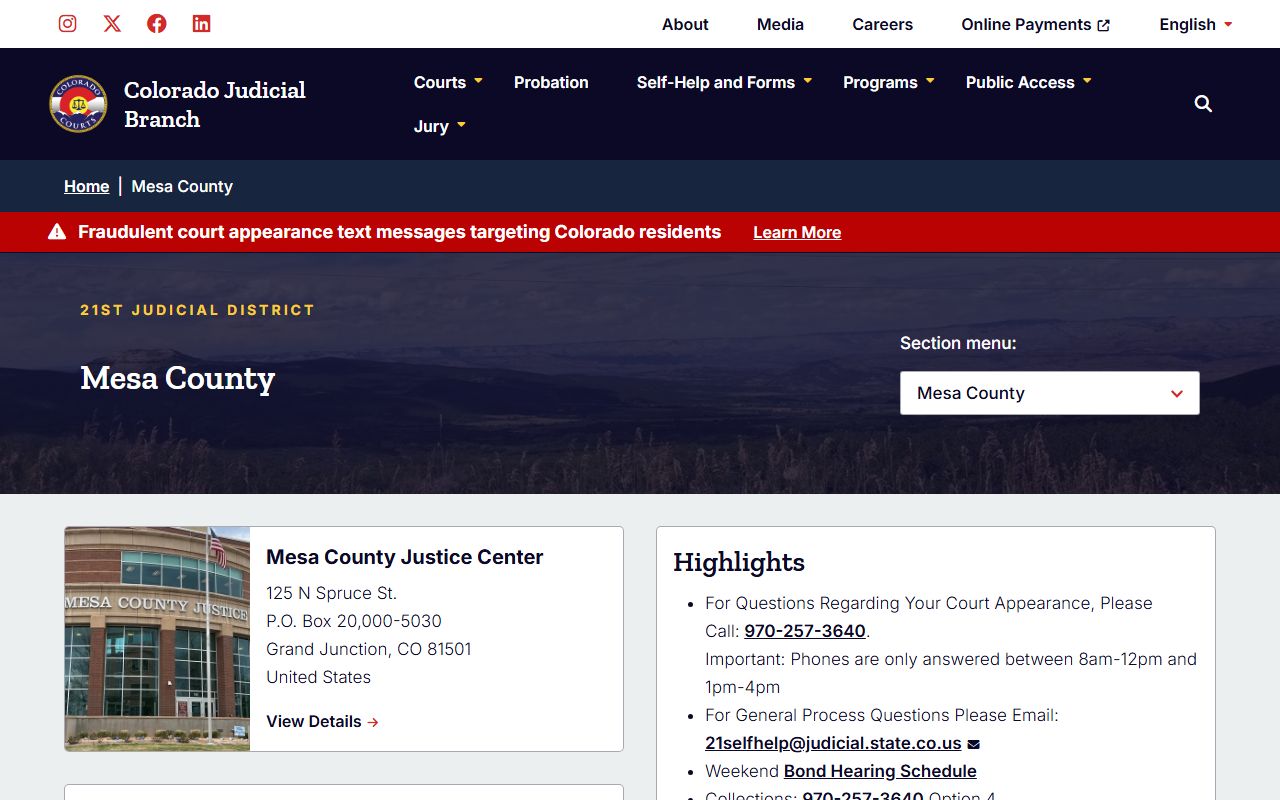
The court page is useful for clerk contact details, but document copies still follow the court's records request process.
Mesa County Court Search Fields
The docket form has many filters. At least one filter beyond date context is required, so a name-only search without a date frame may not work the way a jail roster search works. Mesa County users should narrow by county, courthouse, court type, case number parts, party name, or attorney data where available.
| Field | Type | Notes |
|---|---|---|
| Judicial District | Dropdown | Can be narrowed to the 21st Judicial District |
| County | Dropdown | Includes Mesa County |
| Court Type | Dropdown | Both, County, or District |
| Date Range | Dropdown | Six months, three months, one month, one week, today, or specific date |
| Party Name | Text | Individual first and last name or business name |
| Case Number Parts | Text and dropdown | Year, case class, and sequence can narrow known cases |
Mesa County Charging Documents
Charges get formal shape through documents filed in court. Colorado Judicial's record request form names Complaint/Information as a document option, and the Mesa County DA's role includes appearing before and advising a Grand Jury. For court records after a jail arrest, the charging document is often the bridge from the jail's booking language to the court's formal case language.
| Document | Who Uses It | What It Does |
|---|---|---|
| Complaint | Law enforcement or prosecutor | Starts or supports a criminal charge in court |
| Information | Prosecutor | Lists filed charges, often in felony or misdemeanor cases |
| Indictment | Grand jury route | Charges a case through grand jury action |
Mesa County Charge Status
A court record after an arrest should be read by charge status, not just by the first charge label found in a jail record. The prosecutor may file different charges from the arresting agency's booking language. The court may later amend, reduce, dismiss, or resolve one count while another remains pending.
| Status | What It Means |
|---|---|
| Pending | The case or charge is still open and has not reached final disposition. |
| Amended / Reduced | The charge changed from its earlier form, often through prosecutor action, plea, or court order. |
| Dismissed | The charge is no longer being pursued or has been ordered dismissed. |
| Disposition | The final outcome of a charge or case, including plea, conviction, dismissal, or sentence. |
| Sentence Order | A court document showing sentence terms after conviction or plea. |
Bond After Mesa County Arrest
Bond connects the jail record and the court record. The county locator warns that bond hearings generally must be held within 48 hours under C.R.S. 16-4-102 and that listed bonds may not reflect all bonds or current holds. A bond entry on a jail profile may include a bond number, type, amount, and associated charges. The current court record is still needed to track hearing events and formal orders.
| Bond Type | How It Works |
|---|---|
| Cash Bond | The full cash amount is paid to secure release when no other hold prevents it. |
| Surety Bond | A licensed bonding agent posts bond under a surety arrangement. |
| Property Bond | Real property equity is pledged through the court clerk process. |
| PR / Own Recognizance | Release is based on a promise to appear, sometimes with a cosigner. |
| No-Bond Hold | Release is unavailable or not yet set because of a court order, warrant, detainer, or other hold. |
Note: Call the jail or court before paying because the official locator says listed bonds may not show every bond or hold.
Mesa County Warrants and Arrest
An outstanding warrant can produce a jail arrest, then a court record after booking. Mesa County Sheriff's Office uses an official CRIMEWATCH warrants page for warrant and most-wanted notices. A sample warrant profile showed fields such as name, age, race, gender, physical description, warrant type, active status, issuing authority, holding department, and created or updated dates.
Warrant records can also be checked through the MCSO Criminal Justice Records Request Form, which includes a background and active-warrant check section. A person arrested on a warrant may appear on the current jail locator after booking, and recent warrant-related bookings can appear in daily Booking Summary Reports.
Charges vs Convictions
An arrest charge is an accusation or booking label. A conviction is an outcome after a plea, trial verdict, or other final court action. Court records after a jail arrest can show both early charge data and later disposition data, so the status field matters.
| Point | Charge | Conviction |
|---|---|---|
| Stage | Accusation or filed count | Final result after plea or verdict |
| Proof Level | Can begin with probable cause or prosecutor filing | Requires a plea or proof beyond a reasonable doubt |
| Record Meaning | Does not prove guilt | Shows the charge was resolved as a conviction |
Sealed Mesa County Arrest Records
Colorado sealing provisions in C.R.S. 24-72-703 through 24-72-706 can restrict public access to eligible arrest and criminal justice records after qualifying non-conviction or conviction events. Sealing is not the same as a casual deletion request. It depends on the statute, the case result, and the court process.
| Point | Sealed | Expunged |
|---|---|---|
| Public visibility | Hidden from most public access after a valid order or qualifying process | More limited concept, often used for records treated as removed or not publicly available |
| Agency access | Some justice agencies may retain limited access | Depends on the specific Colorado law and record type |
| Mesa County route | Start with the court record and sealing law | Do not assume the sheriff can remove all public traces without legal authority |
Request Mesa County Court Records
When the docket does not provide the document, the Colorado Judicial record/document request form is the official statewide route. It can be used for Complaint/Information, Disposition/Sentence Order, Protection Order, Ticket, other documents, or a Register of Action. Colorado Judicial describes the Register of Action as a brief explanation of the case, including charges, sentences, and minute orders.
The Colorado Judicial record/document request form collects county, case type, party data, requested document type, and contact information.
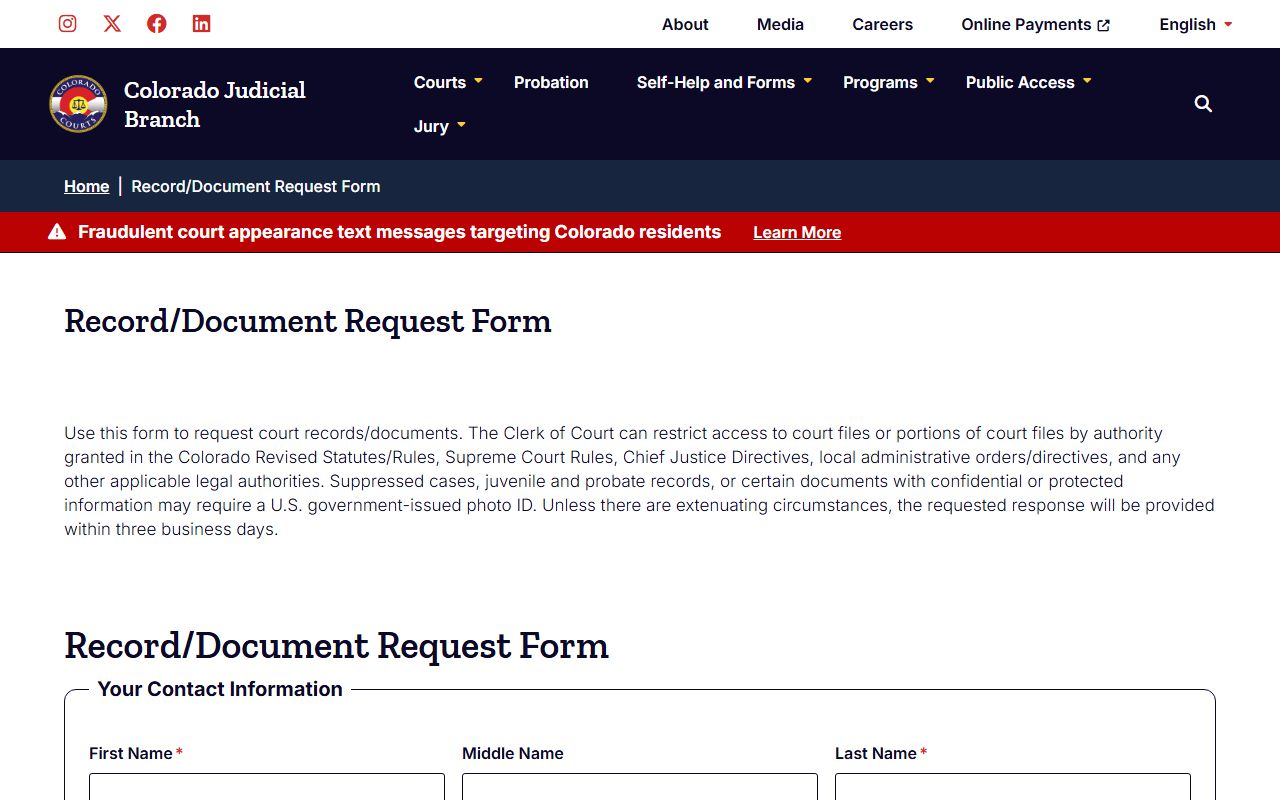
The form notes that some records can require government photo ID, and that response is requested within three business days unless extenuating circumstances apply.
| Court Records Item | Fee |
|---|---|
| Copy per page | $0.25 |
| Max copy fee for parties or attorneys | $15.00 |
| Certified or exemplified copy per document | $20.00 |
| Name search | $5.00 |
| Research or redaction after first hour | $30/hour, 15-minute increments |
Restricted Mesa County Court Records
Colorado Judicial warns that access may be restricted by statutes, rules, Supreme Court Rules, Chief Justice Directives, local orders, and other authority. Suppressed matters, juvenile records, probate records, victim or witness information, and protected details may be withheld or require identification. CORA and CCJRA also allow denial or redaction when release would conflict with law or public-interest limits.
Important: Public court and jail records are not consumer reports and cannot be used for FCRA-covered screening decisions.